The Six Jars Method: A Simple Way to Manage Your Money
The Six Jars Method helps you do more than track expenses. It lets you decide in advance how you want to use your income.
The idea is simple: whenever you receive money, you divide it among several financial priorities. One portion covers everyday living expenses, while the rest goes toward savings, education, enjoyment, building wealth, and helping others.
This way, your money is no longer treated as one large balance. Every part of it has a specific purpose.
More Than Expense Tracking
Traditional expense tracking helps answer the question:
“Where did my money go?”
That is useful, but it is often not enough. Even if you regularly record your purchases, there is no guarantee that you will have money left at the end of the month for savings, education, or major goals.
The Six Jars Method takes a different approach. It helps you answer another question in advance:
“What do I want to use this money for?”
You divide your income before you start spending it. This means savings no longer depend on whatever happens to be left at the end of the month, and everyday expenses do not consume everything available.
How the Six Jars Method Works
In the classic version of the method, every amount of income is divided among six jars.
Necessities — 55%
This jar is intended for essential everyday expenses such as:
- housing;
- groceries;
- transportation;
- utilities;
- phone and internet services;
- healthcare;
- other regular needs.
This money covers your everyday needs.
Financial Freedom — 10%
Money in this jar is intended to help you build capital and generate income in the future.
In the classic system, this money is not used for everyday purchases. Its purpose is to gradually create a source of long-term financial security.
How you use it depends on your knowledge, goals, and tolerance for risk. You might choose savings products, investments, or other ways of building capital.
Long-Term Savings — 10%
This jar helps you prepare for major expenses in advance.
For example:
- building an emergency fund;
- a vacation;
- home improvements;
- buying electronics or appliances;
- a car;
- moving;
- other major goals.
These expenses are easier to handle because you save for them gradually.
Education — 10%
This money is intended for developing your knowledge and skills.
You can use it for:
- books;
- courses;
- professional training;
- language learning;
- lessons with a teacher or tutor;
- conferences;
- other educational materials.
Education becomes a separate part of your budget instead of an expense you keep putting off.
Play — 10%
This jar is intended for recreation and enjoyable purchases.
For example:
- meeting friends;
- cafés and restaurants;
- games;
- hobbies;
- trips;
- events;
- small spontaneous purchases.
Having a separate budget for entertainment lets you enjoy yourself without constantly feeling guilty. You have already set this money aside specifically for things you enjoy.
Give — 5%
This jar can be used for:
- gifts;
- charitable donations;
- helping family and friends;
- supporting projects and causes that matter to you.
These expenses also become a planned part of your budget and do not interfere with your other financial goals.
Adjust the Percentages to Fit Your Situation
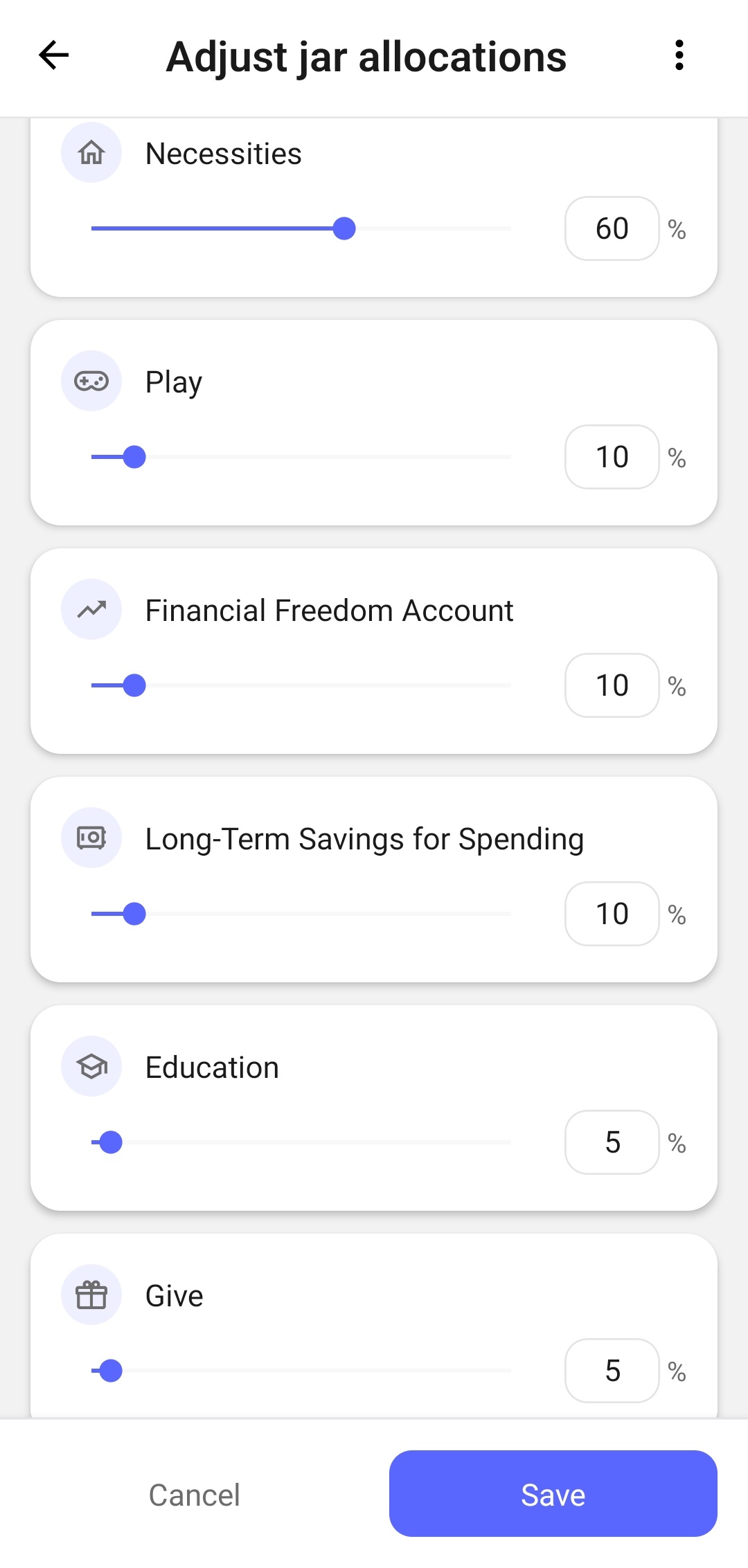
The 55%, 10%, 10%, 10%, 10%, and 5% split is a starting point, not a mandatory rule.
People have different incomes, housing costs, family circumstances, goals, and obligations. For one person, 55% may be enough to cover necessities. For someone else, rent and groceries alone may take up most of their income.
That is why the percentages can and should be adapted to your actual situation.
For example, you can:
- increase the share assigned to necessities;
- temporarily put more money into your emergency fund;
- reduce entertainment spending;
- reach a specific savings goal faster;
- adjust the percentages after your income increases or decreases.
The important part of the method is not following the classic percentages exactly. It is developing the habit of regularly dividing your money among different priorities.
The system should help you make decisions, not become another source of pressure.
Try the method with 6 Jars Finance →The Same Type of Purchase Can Come from Different Jars
The Six Jars Method does not have a universal list that assigns every type of purchase to one specific jar. What matters is not only what you bought, but why you bought it.
For example, a visit to a café could come from different jars:
- Necessities, if it is your regular lunch during the workday;
- Play, if you went there to relax or treat yourself;
- Give, if you are paying for someone else.
You decide what purpose the expense serves based on the situation and your own goals.
The method does not force you to follow rigid rules. It gives you a useful framework and helps you consciously decide which part of your budget should cover a particular purchase.
What It Looks Like in Practice
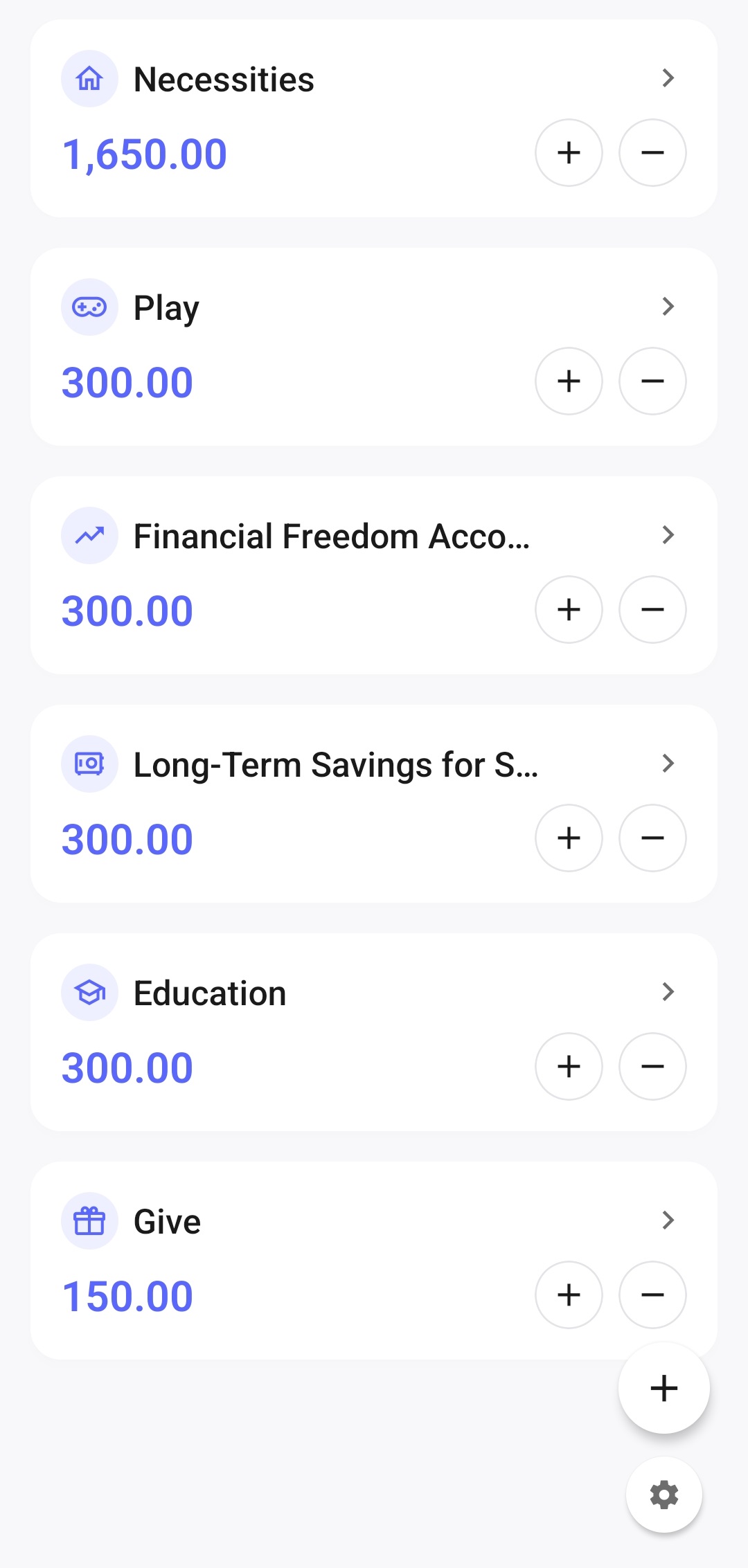
Suppose you receive 3,000 in income.
Using the classic percentages, the money would be divided as follows:
| Jar | Share | Amount |
|---|---|---|
| Necessities | 55% | 1,650 |
| Financial Freedom | 10% | 300 |
| Long-Term Savings | 10% | 300 |
| Education | 10% | 300 |
| Play | 10% | 300 |
| Give | 5% | 150 |
Once the money has been divided, every purchase comes from a specific jar.
Groceries come out of the Necessities jar. A course comes out of Education. A vacation comes out of Long-Term Savings, and meeting friends comes out of Play.
You can then see not only your total remaining balance, but also how much is available for each specific purpose.
Why Your Total Balance Can Be Misleading
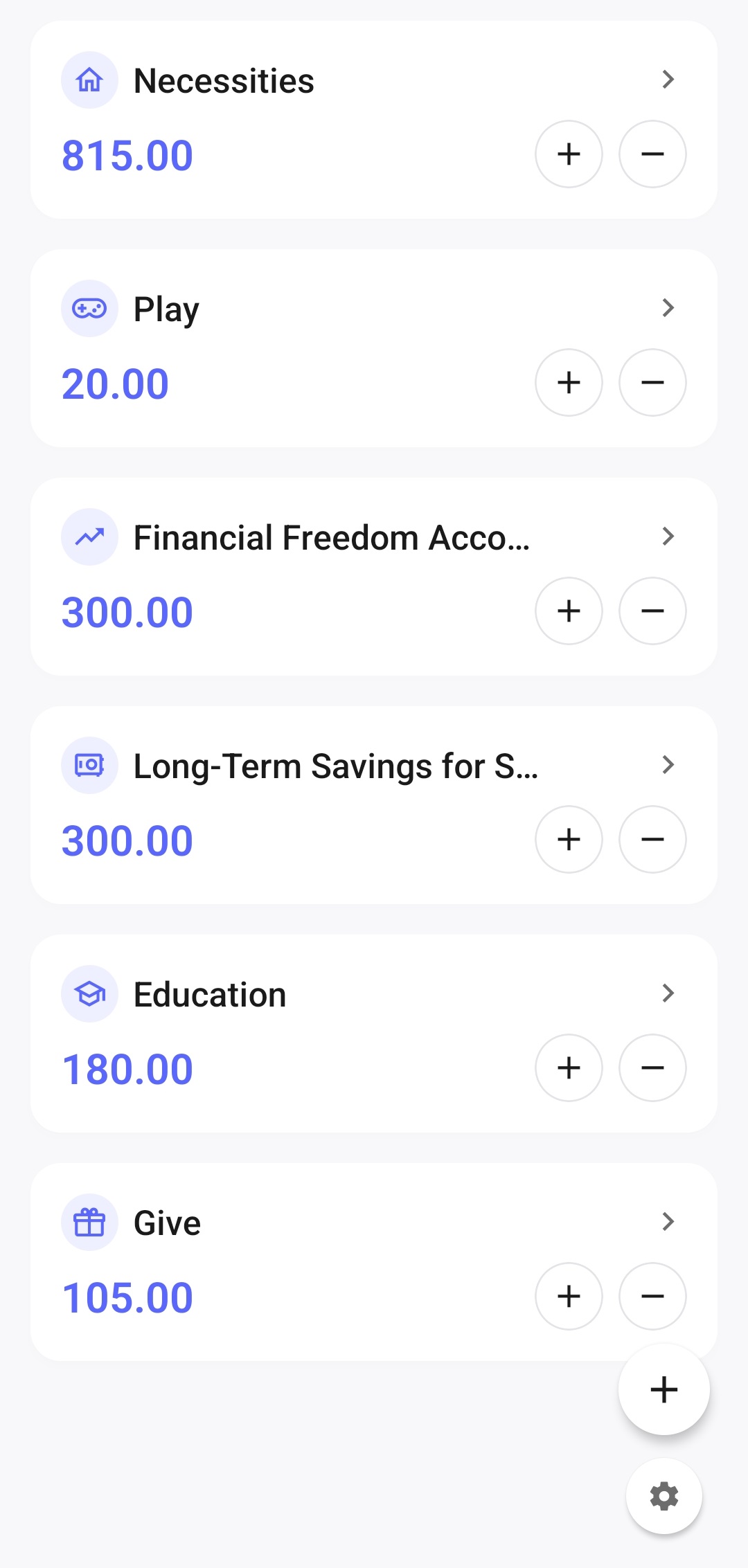
When all your money is kept in one bank account, the available balance can look larger than it really is.
Suppose the account contains 1,720. Technically, all of that money is available. However, some of it may already be set aside for housing, some for a future vacation, and some for an emergency fund.
If you treat the entire balance as money you are free to spend, it is easy to use funds that were already needed for other purposes.
The Six Jars Method helps you mentally divide your total balance.
You may see 1,720 in your bank account, but only 20 of that amount is available for entertainment. The rest has already been set aside for other spending categories.
Savings No Longer Depend on What Is Left Over
One common approach to saving looks like this:
spend money throughout the month, then save whatever is left.
The problem is that there is often nothing left.
The Six Jars Method reverses the order. Money for savings, building capital, and other goals is set aside as soon as you receive income.
You do not have to wait until the end of the month to find out whether you managed to save anything. Savings become part of your budget from the beginning.
Financial Decisions Become Easier
Many purchases do not have one clearly right or wrong answer.
Can you buy a new device? Should you go to a restaurant? Is a course too expensive? Can you afford to take a vacation right now?
When all your money belongs to one general budget, you have to make each of these decisions from scratch.
The jars create clear boundaries.
If there is enough money in the appropriate jar, the purchase fits your plan. If there is not enough, you can postpone the purchase, reconsider the goal, or consciously use money from another jar.
The method does not prevent you from changing your decisions. It makes the consequences of those decisions visible.
You Can Spend Without Constant Guilt
Financial discipline is often mistaken for constantly denying yourself enjoyable purchases.
However, an overly strict system that allows only essential expenses usually does not work well in the long run. People need rest, entertainment, and the freedom to occasionally spend money simply for enjoyment.
That is why the method includes a separate Play jar.
When money has already been set aside for entertainment, you can use it for its intended purpose. The purchase does not interfere with your savings or take money away from essential expenses.
You are not breaking your budget—you are following it.
Borrowing Money from Yourself
As you continue using the Six Jars Method, you gradually build up money that is set aside for different purposes. This means that a temporary shortage does not always require borrowing from other people or using credit.
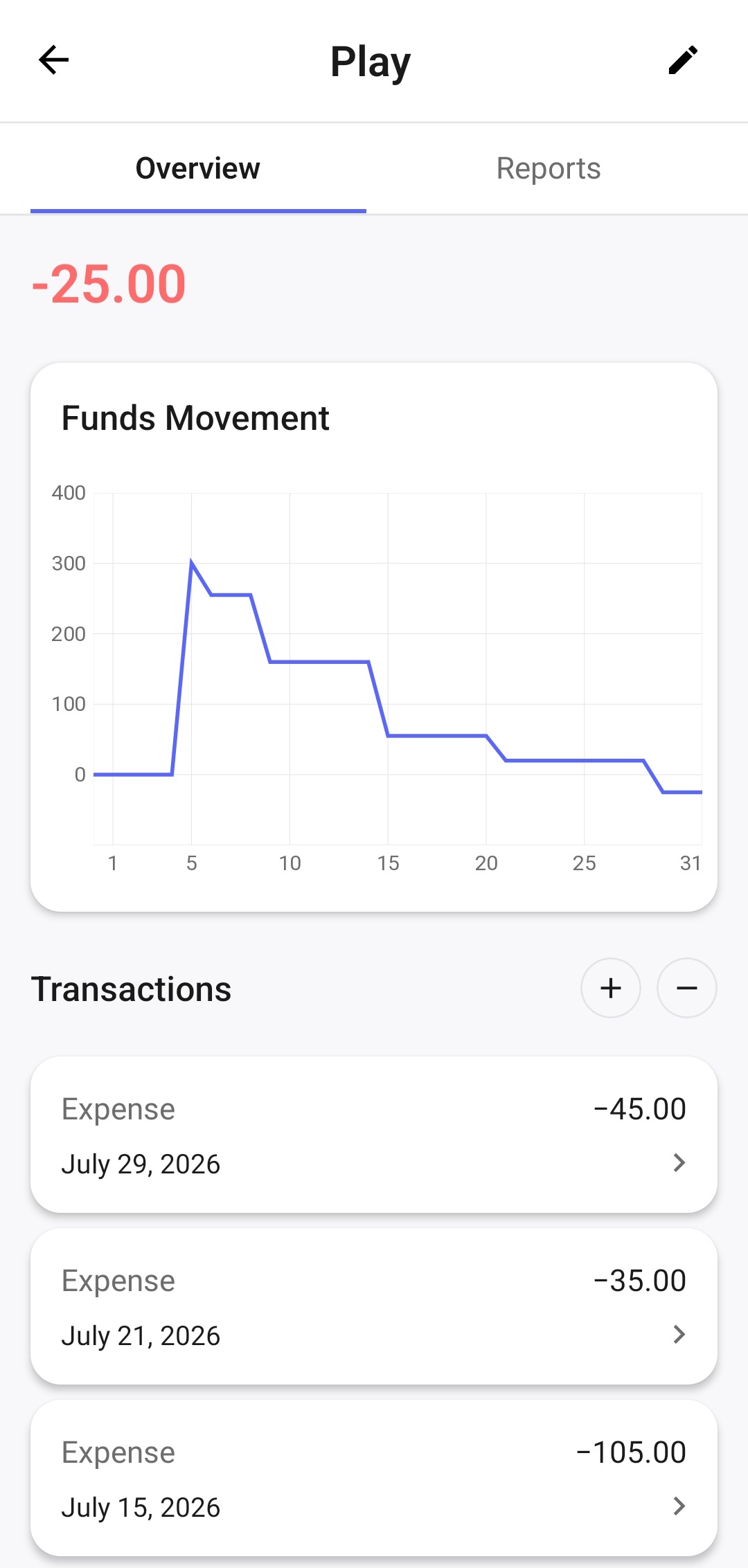
If one jar does not contain enough money for an important purchase, you can temporarily let its balance go below zero. In effect, you are borrowing money from yourself: the purchase is covered by your total available funds, but the overspending is still recorded in the jar the purchase belongs to.
The next time you receive income, the negative balance is reduced or cleared. This means less money will be available in that jar during the next period. The system does not prevent an important purchase, but it clearly shows how that purchase affects your future budget.
Technically, you could transfer the required amount from another jar and return it after receiving more income. However, I do not recommend doing this unless necessary. Such a transfer hides the actual overspending in the original jar and makes your reports less useful. It becomes harder to see which areas regularly need more money than you have set aside for them.
Leaving the jar below zero keeps your expense history accurate. You can see where the overspending happened, how large it was, and whether it was covered after you received more income.
In my experience, this became one of the most noticeable benefits of using the method: I stopped borrowing money from other people because, when necessary, I could temporarily borrow it from myself.
If the same jar regularly falls below zero, it is no longer a temporary exception. It is a sign that you should reconsider how you divide your income. You can increase the percentage assigned to that jar by reducing the shares of jars that usually have money left over. This is what makes the method flexible: the system gradually adapts to your actual spending instead of forcing you to follow fixed percentages.
Financial Goals Stop Competing with One Another
Without a system, any unassigned money is expected to cover everything at once:
- an emergency fund;
- a vacation;
- education;
- new electronics;
- entertainment;
- unexpected expenses.
As a result, one goal often pushes the others aside. A large purchase can completely interrupt your savings, while an unexpected expense can cancel a planned vacation.
Dividing your money by purpose allows you to keep working toward several goals at the same time.
Even if the amounts are small at first, every important area receives a share whenever you receive income.
The Method Helps Build Financial Discipline
The main value of the method lies not only in how the money is divided, but also in the habits you develop by using it.
Regularly dividing your income gradually changes the way you think about money. Instead of seeing each payment as one pool you can spend until it runs out, you begin to see it as a resource for different areas of your life.
You develop the habit of:
- dividing your money before spending it;
- considering the consequences of each purchase;
- regularly putting money toward future goals;
- maintaining a balance between what you want today and your long-term plans;
- making conscious financial decisions.
The system does not require perfect behavior from day one. Financial discipline develops gradually through repeating the same simple actions.
In my own experience, this turned out to be the method’s main advantage. It did not simply help me track my money more effectively—it gradually changed the way I approached income, spending, and saving.
What to Do If Your Income Is Irregular
The method works even if you do not receive a fixed monthly salary.
If your income is irregular, divide each payment separately.
Whenever you receive payment for a project, freelance work, an order, or a sale, divide that amount among the jars using your chosen percentages.
With an unpredictable income, it can be especially useful to increase the share you put into your emergency fund. This helps you get through periods when less money is coming in.
The method does not require you to know your exact monthly income in advance. It works with money you have already received.
What If Money Is Tight?
The classic percentages may not work well for someone who spends almost all of their income on basic needs.
That does not mean the method is useless.
You can start with a more realistic split. For example, you could put 80–90% toward necessities and divide the remaining amount among the priorities that matter most to you.
Even a small amount regularly put into an emergency fund or toward a long-term goal helps you build the habit.
As your income and expenses change, you can adjust the percentages.
What matters is not the size of the first step, but taking it consistently.
Do You Have to Use Exactly Six Jars?
No.
Six jars form the foundation of the classic method. They cover the main financial priorities and provide a useful starting point.
Over time, however, you can adapt the system.
For example, you can create separate jars for:
- a vacation;
- healthcare;
- a car;
- home improvements;
- pets;
- children;
- taxes;
- electronics;
- a specific major purchase.
You can also combine or rename some of the classic jars.
The important thing is to preserve the main principle: your money should be divided by purpose, and the structure should reflect your life.
The Problem with Physical Jars and Envelopes
Systems like this were originally designed around cash.
You could physically divide your income among separate jars, boxes, or envelopes. This made the system easy to understand because money intended for different categories was actually kept apart.
Today, however, most financial transactions are digital.
We receive income in a bank account, pay by card, purchase services online, and transfer money using our phones.
Under these conditions, physical jars become inconvenient. Maintaining the system would require regularly withdrawing cash or manually recording every card and digital payment.
You could open several bank accounts, but managing a large number of accounts and transfers is not always convenient either. The number of available accounts and their terms also depend on your bank.
Digital Jars
I ran into this problem myself.
I liked the idea behind the Six Jars Method, and using it regularly genuinely helped me develop a more disciplined approach to money.
However, physical jars and envelopes were inconvenient in a world where most payments are made digitally.
That is why I developed 6 Jars Finance, a personal finance app based on the Six Jars Method.
The app preserves the main idea of the system without requiring you to physically separate your money.
You keep your money in your usual bank account, while the app shows a separate balance for each jar.
How 6 Jars Finance Works
When you receive income, the app divides it among the jars according to your chosen percentages.
After making a purchase, you specify which jar the money came from. Only that jar’s balance decreases, while the money in the other jars remains set aside for its original purposes.
This gives your total bank balance a clear internal structure.
You can see:
- how much money is available for necessities;
- how much you have saved for long-term goals;
- how much you can spend on entertainment;
- how much has been set aside for education;
- how the balances of your jars change over time.
The app does not move money between bank accounts and does not connect to your bank. It helps you keep a separate record and understand what each part of your money is intended for.
Do You Need to Enter Every Purchase Separately?
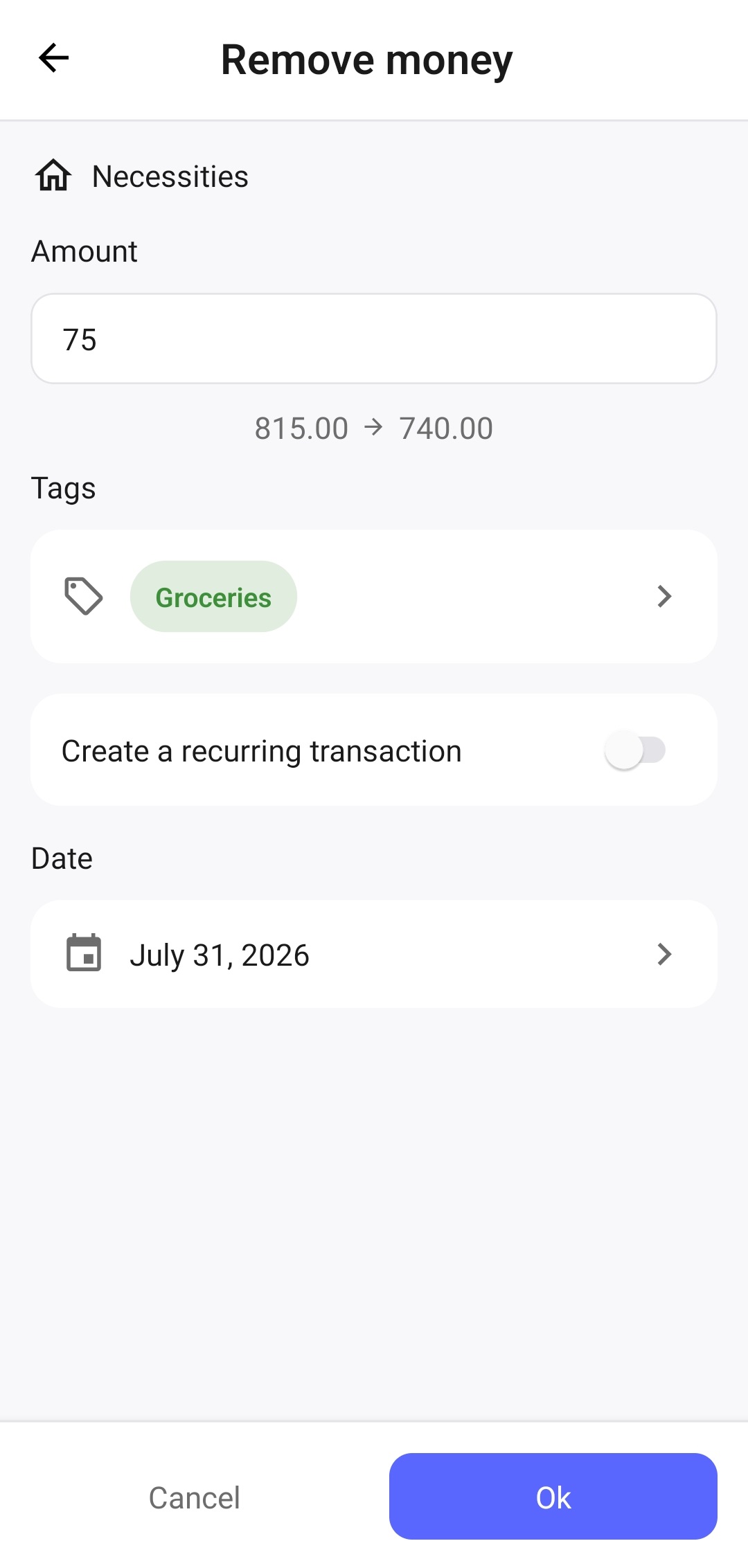
No. To use the method, you only need to enter the total expense and select the jar the money came from.
For example, you can record a regular trip to the store as a single expense of 105. If you want more detail, you can split it into several expenses: 75 for groceries and 30 for household supplies. You can also use tags for additional detail.
You decide how much detail is useful to you. The app does not require you to copy every item from a receipt. Tracking should help you understand where your money goes without taking too much time.
Manually entering an expense takes a small amount of effort, but it also helps you notice your spending and better understand where your money goes.
Adapt the System to Your Needs
6 Jars Finance is based on the classic method, but it does not limit you to the original structure.
You can:
- change the allocation percentages;
- rename jars;
- create your own jars;
- use more or fewer than six jars;
- change the order of the jars;
- record income and expenses;
- add recurring transactions;
- analyze your cash flow using reports.
The classic structure can provide a convenient starting point. From there, you can gradually adjust it to fit your own needs.
Start with Your Next Income
You do not need to immediately rebuild your entire financial system or follow the classic percentages perfectly.
Start with one simple step: divide your next income among several priorities that matter to you.
Even this first step will help you see your money not as one large balance, but as a tool for different areas of your life.
In 6 Jars Finance, the six jars and their default percentages are already set up. You can start right away and adjust the allocation later if needed.
Explore 6 Jars Finance →